Mr. Rogers, an avowed Socialist, an unironic Yankees fan (this was before Moneyball), and teacher at our high school, had once tried to explain the merits of The Sun Also Rises.
I listened as he mused about Hemingway’s masterpiece and became annoyed.
I didn’t like the book.
In echoes of my ‘came-of-age-during-the-Reagan-era’ father, I wondered: “Why are they going around complaining all day and drinking their lives away in Spain while brooding, when they could be doing something or getting a job?”
Mr. Rogers responded along the lines of: “you have to understand the time period this was written in” or some words vaguely similar.
They were called the Lost Generation. They had just come back from the Great War; their lives shattered; nothing held any meaning anymore.
All the great promises and dreams of the industrial revolution that first sprang up in Manchester, England, metamorphized into the horrors of modern warfare.
And everything they were taught and believed in no longer made any sense.
“To come back from the Great War that was by all accounts pointless and had not really served in America’s interest…not unlike the events surrounding our current Mad King George….” and, cue the side sneer at our beloved Commander-in-Chief.
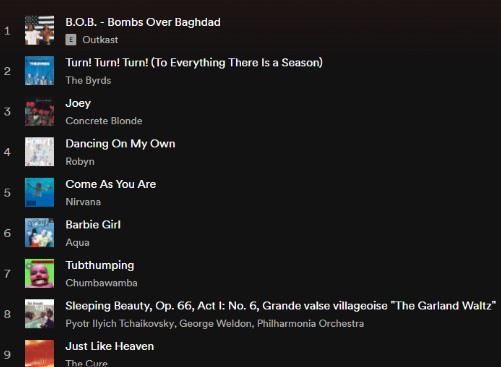
“Throughout American history”, Mr. Rogers said, in another class, “there has always been a great pendulum swing between liberalism and conservatism, and right now we are still in an age of conservatism. I imagine that…” — Myself, I imagined Bombs over Baghdad¹ and freedom fries, and hummed a little tune from a decade he seemed to be so preoccupied by:
In another lecture. at another time, he let us know this: “You, here, at this College Preparatory — this high school – this is a bubble. And soon you’ll be going off to another bubble” – before vaguely pointing in the direction of the University of Arizona.
—–
When I did finally claw my way out of that second bubble, the market crashed. My brother had just killed himself³, and myself and my generational cohorts, entered an environment replete with unpaid internships, or contract jobs if we were lucky. Shackled by student loan debt, highly educated, somehow frequently overqualified and jobless, I left to do the only thing I could think of: go to Europe, be with my one true love, get even more educated, and hope something made sense after that.
It was there I found myself in my twenties dancing and drinking throughout London⁴, trying to climb up any underpaid ladder, somehow an anxious person making her way into the field of security.
Open-source intelligence indicates there is a likelihood of protests outside the Benghazi Consulate.
I’m sorry sir, your home country is undergoing some kind of government overthrow;
No, we are an able to book you flights out of Istanbul at this time.
And in our own little life –
Cheap flights, package deals, trips tacked onto work events abroad.
Let’s go to Milan!
to Paris!
Isis attacks!
Brexit!
Trump!
And yet — nothing did make sense.
Reagan had died some years before. Up was down; right was left; conservatives were liberals; liberals were conservatives; the republicans were now anti-war and against free trade; liberals were now supporting the neoliberalism ideals of Bush.
And in London-
We’ll never be able to buy that house or have the kids we might as well drink!
Let’s dance!
Our grandparents fought the twin evils of fascism and communism and made the world a better place only to see it torn apart by their own children!
Gen X- who cares? They did provide great entertainment though (grunge⁶, Friends – oh how we all wanted to live in the show Friends)

Let’s drink!
In Copenhagen, I locked myself out of my AirBnB and was forced to stay up all night at a gay club listening to the syrupy sounds of Aqua⁵ on repeat. It was there I met a Scandinavian who lamented the downfall of Western civilisation, blaming it on the region’s “failure to follow our true religion, that of the Norse gods”.
In Spain’s Basque region, I ran with a single bull.
In Brussels, I saw a Walloon man drape the Belgian tricolour next to a sign that read: “We beat Iraq, 541 days without a government!”
In Istanbul, I saw the Hagia Sophia; in Dublin: “Every American that comes here says they’re Irish. But really, they’re half this, a half that, and when I ask them about it, it’s always their great-great-grandfather – that’s not Irish. They’re Plastic Paddy’s!” In Tokyo: “no 1 sport is base-eh-bol, not the fat man!”
In Amsterdam…I forget.
But back in London, oh yes London the forerunner of globalisation, that by-product of capitalism made known by the Scottish Smith, an American, a Hungarian, a German, a Russian and three-salt-of-the-earth Brits peered out over a semi-high rise apartment rooftop over the London Eye, which had been lit up in blue as a warning that the U.K. was — maybe perhaps could be? Let’s negotiate further? Can we keep Northern Ireland with us?– going to pull off the impossible: we were leaving the EU.
I don’t care! This is going to be our year! This is going to be our decade! We cried.⁷
3
2
1
Then, suddenly, the world stopped.
And to the horror of every Brit: the pubs closed.
And then:
Pitter Patter
Pitter patter
Pitter patter
A new life emerged. A new start, a chance to begin again: Generation Alpha had arrived, and with the pinkest of feet.⁸
———
Back, way back, some twenty years ago, Mr. Rogers pulled out a book I did like. Betty Smith’s A Tree Grows in Brooklyn.
Its story took place nearly a century before Williamsburg turned itself into a millennial apocalypse, complete with Soul Cycle-farm-to-table-craft-beer-bearded-men-what-have-you’s.
As is so often the case in American literature, the most important observations come from that of a young girl (think Scout in To Kill a Mockingbird) – in this case the fictional Francine’s half- Irish, half-Austrian American life was about to be consumed by calls for Freedom Cabbage ahead of her country’s entry into the Great War.
And, Mr Rogers argued, one of the greatest scenes in all American literature, is thus:
Francie stared at the oldest man. She played her favorite game, figuring out about people. His thin tangled hair was the same dirty gray as the stubble standing on his sunken cheeks.
Dried spittle caked the corners of his mouth. He yawned. He had no teeth. She watched, fascinated and revolted, as he closed his mouth, drew his lips inward until there was no mouth, and made his chin come up to almost meet his nose. She studied his old coat with the padding hanging out of the torn sleeve seam. His legs were sprawled wide in helpless relaxation and one of the buttons was missing from his grease-caked pants opening.
She saw that his shoes were battered and broken open at the toes. One shoe was laced with a much- knotted shoestring, and the other with a bit of dirty twine. She saw two thick dirty toes with creased gray toenails. Her thoughts ran….
“He is old. He must be past seventy. He was born about the time Abraham Lincoln was living and getting himself ready to be president. Williamsburg must have been a little country place then and maybe Indians were still living in Flatbush. That was so long ago.” She kept staring at his feet. “He was a baby once. He must have been sweet and clean, and his mother kissed his little pink toes”.
“Think about that for a moment”, Mr Rogers paused. We all had baby feet once⁹
 Thoughts from across the pond
Leave a comment